
The construction sector has historically been characterized by physical labor, heavy machinery, and fragmented communication. For decades, project management relied on paper blueprints, manual status updates, and retrospective cost accounting. This traditional approach frequently created significant operational liabilities, including severe schedule overruns, unpredictable material waste, and heightened safety hazards on the jobsite.
Modern builders must operate within an increasingly complex commercial environment. Persistent labor shortages, fluctuating material costs, and stringent environmental regulations require construction firms to maximize operational efficiency. To address these systemic pressures, the industry is undergoing a profound digital transformation. By integrating advanced software networks, connected hardware devices, and autonomous machinery, construction companies are elevating field productivity and establishing a highly predictable, data-driven methodology for building infrastructure.
Every successful construction project starts with reliable Earthworks Services that prepare the land for safe and efficient building. From excavation and grading to site leveling and drainage, professional earthworks ensure a stable foundation while helping projects stay on schedule, within budget, and compliant with local construction requirements.
The Infrastructure of Connected Jobsite Ecosystems
The modern construction site is no longer an isolated physical environment. Instead, it functions as an interconnected data ecosystem where real-time information flows continuously between field crews, design engineers, and corporate executives. This connectivity is driven by the maturation of cloud computing and unified digital platforms.
When operational data is centralized, organizations eliminate the communication breakdowns that have traditionally delayed large-scale developments. Field supervisors utilize mobile applications to access updated architectural modifications instantly, reducing the risk of errors. This real-time accessibility minimizes construction rework, accelerates executive decision-making, and ensures that all project stakeholders operate from a single, verified source of truth.
Core Smart Technologies Transforming Construction Workflows
A sophisticated suite of integrated technologies forms the foundation of smart construction, with each asset targeting specific operational inefficiencies across the project lifecycle.
Building Information Modeling and Digital Twins
Building Information Modeling has evolved from a basic three-dimensional drafting tool into a comprehensive multidimensional project controls framework. Modern applications integrate scheduling data and cost parameters directly into the digital design.
-
Clash Detection: Before ground is broken, software engines analyze structural, mechanical, electrical, and plumbing schematics simultaneously. The system flags geometric conflicts, such as a structural beam intersecting a ventilation duct, allowing engineers to resolve errors digitally rather than during expensive field installations.
-
Digital Twin Interoperability: Once construction concludes, the final model transitions into a dynamic digital twin. By linking the model to physical sensors embedded within the finished facility, building operators can monitor real-time energy consumption, structural integrity, and HVAC performance throughout the asset life.
The Internet of Things and Proximity Wearables
The Internet of Things utilizes a network of connected sensors to monitor physical assets, environmental variables, and labor forces on the jobsite.
-
Asset Telematics: Heavy machinery equipped with GPS and diagnostic sensors transmits continuous data regarding fuel efficiency, equipment utilization, and component wear. This visibility enables predictive maintenance protocols, allowing mechanics to service equipment before a mechanical failure stalls site operations.
-
Worker Safety Wearables: Field personnel utilize smart helmets, high-visibility vests, and proximity badges equipped with biometric and location sensors. These devices monitor vital signs for heat fatigue, detect slip-and-fall events instantly, and emit automated alerts when a worker walks into a hazardous high-risk equipment zone.
Autonomous Reality Capture and Aerial Drones
Manual site surveying is historically slow and prone to human measurement errors. Autonomous drones and terrestrial rovers have industrialized this process through high-definition reality capture.
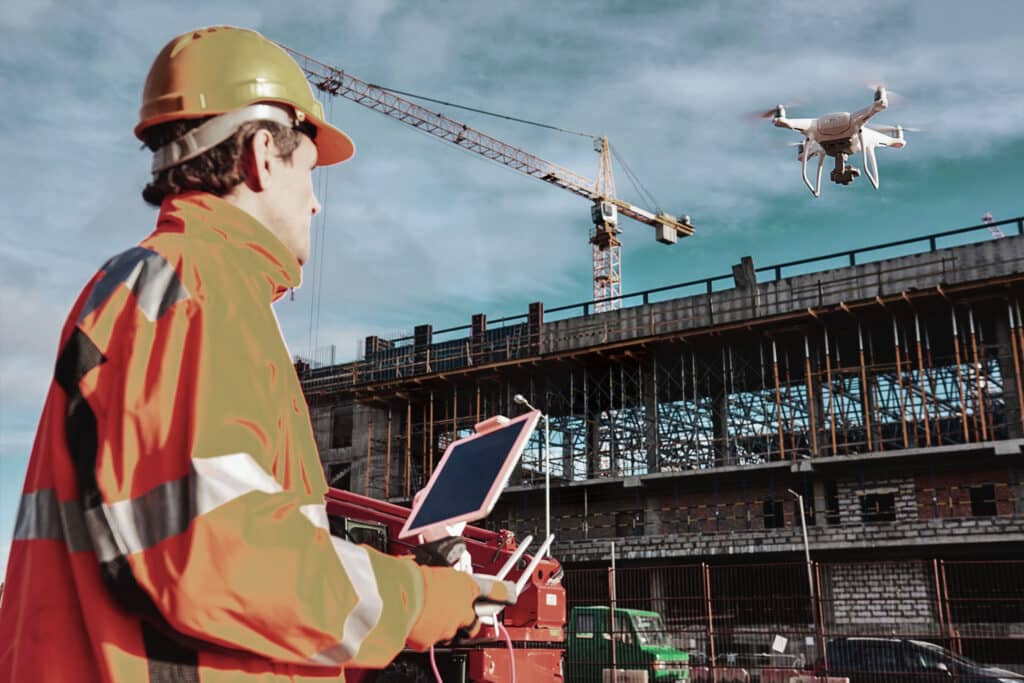
Equipped with Light Detection and Ranging sensors and photogrammetry software, drones execute pre-programmed flight paths over a jobsite within minutes. The system captures millions of precise data points to generate high-resolution topographical maps and three-dimensional point clouds. Project controls software then automatically compares these physical scans against the master schedule and architectural models, verifying work quality and calculating exact material volumes, such as the precise cubic yardage of an earthwork excavation.
Robotics and Site Automation
To combat the global deficit of skilled trade labor, contractors are systematically deploying specialized robotics to execute repetitive, physically exhausting, or high-risk tasks.
Semi-automated masonry systems assist human workers by handling the heavy lifting, mortar application, and placement of bricks, which accelerates production while minimizing worker strain. Similarly, autonomous layout robots travel across concrete floor slabs to physically print highly accurate installation guides directly onto the surface using computerized computer-aided design files, eliminating manual measuring tape workflows. For dangerous environments, remote-operated demolition robots dismantle concrete structures without exposing field personnel to falling debris or structural collapses.
Operational Blueprints for Scaling Technology Adoption
Deploying an enterprise-grade smart construction framework requires a structured implementation strategy that goes beyond software procurement to address organizational culture.
Standardizing Data Architecture and Cleaning Pipelines
The insights generated by advanced analytics tools are entirely dependent on the quality of the underlying data streams. Organizations must establish strict data governance policies before implementing field technologies. This process involves standardizing how RFIs, change orders, and daily field logs are formatted and categorized across all active projects. Without uniform data structures, information remains fragmented, preventing machine learning algorithms from identifying cost trends or scheduling risks accurately.
Implementing Phased Pilots and Training Field Champions
Attempting an all-at-once technological rollout across an entire enterprise typically triggers intense operational friction and user rejection. Successful firms utilize a phased implementation model, selecting a mid-sized project with a tech-literate field team to serve as a controlled pilot environment.
Leadership must designate specific field personnel as technology champions. These individuals bridge the gap between office software developers and field crews, providing peer-to-peer training and demonstrating how the technology actively reduces paperwork and streamlines daily coordination. Documenting measurable wins during the pilot stage creates the organizational buy-in necessary to scale the tools across the broader corporate portfolio.
Frequently Asked Questions
What is the primary difference between 3D, 4D, and 5D Building Information Modeling?
Three-dimensional BIM focuses purely on the spatial geometry of a structure. Four-dimensional BIM integrates the master project schedule directly into that spatial model, enabling visual sequencing simulations over time. Five-dimensional BIM adds the financial layer, linking material quantities and schedule phases to real-time cost estimates and budget tracking.
How does smart construction technology support corporate sustainability and environmental compliance?
Smart technologies enhance sustainability by utilizing material optimization algorithms that prevent over-ordering and minimize site waste. Additionally, connected sensors track heavy machinery idle times to reduce carbon emissions, while automated energy modeling software assists engineers in designing high-performance building envelopes that adhere to strict green building certifications.
What technical infrastructure is required to support real-time data streaming on a remote jobsite?
Real-time field data streaming relies on robust wireless connectivity, often achieved by deploying localized mesh networks, industrial-grade cellular routers, or satellite communication terminals on site. This communication layer allows field devices, wearables, and machine telematics to transmit information to cloud databases without latency.
How do autonomous drones reduce project insurance premiums for large contractors?
Drones lower insurance liabilities by eliminating the need for human surveyors to climb high-elevation scaffolding or navigate unstable terrain for inspections. Furthermore, the continuous, high-definition visual documentation created by drone scans provides irrefutable photographic evidence of site conditions and safety compliance, reducing risk exposure.
What is self-healing concrete and how does it function within smart infrastructure?
Self-healing concrete is an innovative material engineered with embedded microscopic capsules containing specific bacteria or chemical healing agents. When structural stress causes a micro-crack to form, the capsules rupture, releasing the active agents to chemically seal the fracture upon contact with moisture, preventing moisture ingress and internal steel corrosion.
How do layout robots improve the workflow of specialty trade subcontractors?
Layout robots automate the tedious process of manual floor marking by using digital blueprints to draft precise lines, anchor points, and mechanical wall boundaries directly onto concrete decks. This automation eliminates human measurement mistakes, allowing mechanical, electrical, and drywall crews to begin structural installations immediately with perfect alignment.
In what ways does computer vision artificial intelligence enhance site security and risk management?
Computer vision platforms analyze live video feeds from jobsite security cameras around the clock. The underlying artificial intelligence is trained to automatically identify safety infractions, such as a worker failing to wear a hard hat, flag unauthorized after-hours site intrusions, and detect early thermal signatures of electrical fires or fluid leaks.